Have you ever had your blood pressure checked and wondered what those two numbers actually mean?
You might have heard someone say their blood pressure is “120 over 80” or seen numbers appear on a digital blood pressure monitor.
But what exactly are these numbers measuring? And why do they matter?
Blood pressure is one of the simplest ways to learn something important about your heart and circulation.
Let’s understand what it means, one step at a time.
1. What Is Blood Pressure?
Think of your heart as a pump and your blood vessels as a network of pipes.
Every time your heart beats, it pushes blood through your arteries, carrying oxygen and nutrients to different parts of your body.
As the blood moves, it exerts pressure against the walls of these arteries.
That pressure is called blood pressure.
Your body needs blood pressure to keep blood circulating and supply vital organs, including your brain, heart and kidneys.
However, blood pressure that’s consistently too high or too low can sometimes be a sign that something needs medical attention.
Medical reference: British Heart Foundation — Understanding Blood Pressure
2. What Do the Two Blood Pressure Numbers Mean?
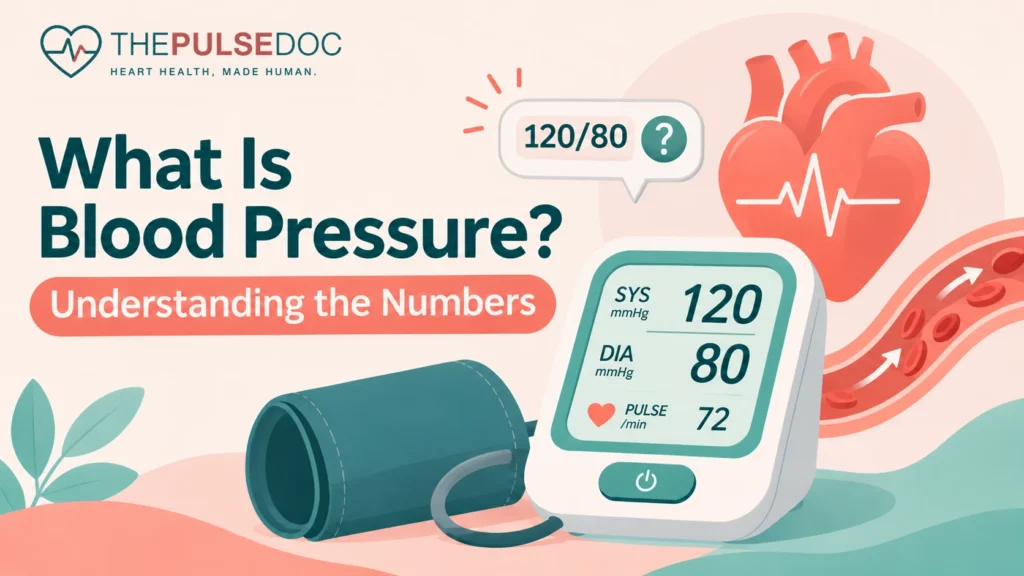
When your blood pressure is measured, you’ll see two numbers, usually written like this:
120/80 mmHg
They’re commonly spoken as “120 over 80.”
The letters mmHg stand for millimetres of mercury, the unit used to measure blood pressure.
Each number tells us something different about what’s happening inside your arteries.
The Top Number: Systolic Blood Pressure
The first, or upper, number is called systolic blood pressure.
It measures the pressure inside your arteries when your heart contracts and pumps blood out.
Think of squeezing a water-filled pump. As the pump pushes water forward, pressure increases inside the connected pipes.
Something similar happens when your heart contracts.
So, in a reading of 120/80, 120 is the systolic pressure.
The Bottom Number: Diastolic Blood Pressure
The second, or lower, number is called diastolic blood pressure.
It measures the pressure inside your arteries when your heart relaxes between beats.
Even when your heart is relaxing, blood continues moving through your circulation, and pressure remains inside your arteries.
In a reading of 120/80, 80 is the diastolic pressure.
Both numbers are important because they provide information about the pressure in your arteries during different phases of your heartbeat.
Medical reference: American Heart Association — Understanding Blood Pressure Readings
3. What Is Considered a Normal Blood Pressure Reading?
This is where things can get a little confusing.
You may have heard that 120/80 mmHg is a normal blood pressure. It’s a familiar reference point, but blood pressure categories are more specific than that.
According to the American Heart Association’s 2025 guidelines, normal blood pressure for most adults is:
- Systolic: Less than 120 mmHg
- Diastolic: Less than 80 mmHg
Both numbers need to be below these values to fall within the AHA’s normal category.
For example, a reading of 118/76 mmHg falls within this range.
However, different medical organisations use somewhat different thresholds when classifying or diagnosing high blood pressure.
For example, the AHA classifies persistent readings starting at 130 systolic or 80 diastolic as hypertension, while UK and WHO guidance commonly uses 140/90 mmHg as a clinical threshold, with additional considerations for readings taken at home.
This doesn’t mean one single reading tells the whole story.
Your blood pressure should be interpreted using properly measured readings over time, your overall health and the guidance followed by your healthcare professional.
Medical references: American Heart Association — Understanding Blood Pressure Readings, NHS — Blood Pressure Test and WHO — Hypertension
4. Does Blood Pressure Stay the Same All Day?
Not at all!
Your blood pressure naturally changes throughout the day.
For example, it may temporarily rise when you:
- Exercise or climb stairs, as your heart works harder to supply your muscles with blood. (Regular exercise, however, can help lower resting blood pressure over time.)
- Feel stressed, anxious or excited, due to your body’s natural stress response.
- Consume caffeine, although its effect varies from person to person.
- Experience pain, which can temporarily affect blood pressure.
Blood pressure generally decreases during rest and sleep.
These short-term changes are different from having persistently high blood pressure.
That’s why one reading taken at one moment doesn’t necessarily reflect your usual blood pressure.
Healthcare professionals often consider repeated readings to get a clearer picture.
Medical references: British Heart Foundation — High Blood Pressure, American Heart Association — Managing Stress and Blood Pressure, Mayo Clinic — Caffeine and Blood Pressure and Heart Foundation of Australia — Blood Pressure and Your Heart.
5. Why Is Knowing Your Blood Pressure Important?
Blood pressure is one of the key measurements used to assess cardiovascular health.
When blood pressure stays too high over time, it can put extra strain on the heart and blood vessels.
Blood pressure that’s too low may also cause problems in some situations, particularly if it leads to symptoms such as dizziness or fainting.
The important thing is that you can’t always tell what your blood pressure is simply by how you feel.
That’s why regular blood pressure checks can be useful, even when you’re feeling well.
If your readings are repeatedly outside the range recommended for you, discuss them with a healthcare professional.
A single unusual reading doesn’t automatically mean you have a medical condition, but it shouldn’t be ignored if it is very high, persistently abnormal or accompanied by concerning symptoms.
Medical references: WHO — Hypertension and American Heart Association — Blood Pressure Explained
6. How Can You Keep Track of Your Blood Pressure?
Blood pressure can be measured at a healthcare facility, pharmacy or at home using a suitable blood pressure monitor.
Keeping a record of your readings can help your healthcare professional understand how your blood pressure changes over time.
If you’re monitoring at home, it’s important to use a validated monitor and follow the correct measurement technique, because even small mistakes can affect the result.
To make recording your readings easier, you can use our 7-Day Blood Pressure Diary, available in the THEPULSEDOC Resources section.
It provides a simple way to keep your blood pressure readings organised so you can review them or share them with your healthcare professional.
For now, remember that understanding the numbers is the first step towards making sense of your readings.
Medical reference: American Heart Association — Home Blood Pressure Monitoring
The Takeaway: Two Numbers That Tell an Important Story
Your blood pressure is the force of blood pushing against the walls of your arteries.
The top number (systolic) tells you the pressure when your heart contracts, while the bottom number (diastolic) tells you the pressure when your heart relaxes between beats.
Both numbers matter, and both can change throughout the day.
Understanding your blood pressure doesn’t mean worrying about every small change. It means recognising what the numbers represent and knowing when to discuss your readings with a healthcare professional.
Knowing your numbers is a simple but meaningful step towards understanding your heart health.
Frequently Asked Questions (FAQs)
1. Is 120/80 a normal blood pressure?
It’s a commonly used reference reading. However, under current AHA guidelines, the normal category is defined as systolic pressure below 120 and diastolic pressure below 80 mmHg. Your healthcare professional can help interpret your readings using the appropriate guidelines.
2. Which blood pressure number is more important?
Both are important. The systolic number measures pressure when the heart contracts, while the diastolic number measures pressure when it relaxes. Healthcare professionals consider both when assessing your blood pressure.
3. Is blood pressure the same as heart rate?
No.
Blood pressure measures the pressure exerted by blood against artery walls.
Heart rate measures how many times your heart beats per minute.
Although they’re related, they are different measurements.
4. Can blood pressure change from one reading to another?
Yes. Blood pressure naturally fluctuates with activity, stress, rest and other factors. Repeated, correctly taken readings are generally more useful than relying on one isolated measurement.
Medical References
- American Heart Association. Understanding Blood Pressure Readings
- American Heart Association. 2025 High Blood Pressure Guideline — Top Things to Know
- British Heart Foundation. High Blood Pressure
- National Health Service (NHS). Blood Pressure Test
- World Health Organization. Hypertension
- National Heart, Lung, and Blood Institute (NIH). High Blood Pressure Diagnosis
- American Heart Association. Home Blood Pressure Monitoring
- American Heart Association. Managing Stress and Blood Pressure
- Mayo Clinic. Caffeine and Blood Pressure
- Heart Foundation of Australia. Blood Pressure and Your Heart
Medical Disclaimer: This article is intended for general health education and does not replace personalised medical advice, diagnosis or treatment. Blood pressure targets and diagnostic thresholds may vary based on age, pregnancy, medical conditions and clinical guidelines. Seek urgent medical attention for severe or concerning symptoms, particularly chest pain, severe breathlessness, sudden weakness or changes in speech or vision.
Written and medically reviewed by: Dr. Laiba Tul Jannat
THEPULSEDOC | Know Your Heart
General education only; not individual medical advice. Speak with a qualified healthcare professional about personal health concerns.
For a suspected emergency, call your local emergency service immediately.