Your heart has a remarkable job. It keeps blood moving around your body, supplying your organs and tissues with the oxygen and nutrients they need.
But have you ever wondered how it manages to do all of this?
How does blood travel through the heart? What keeps it moving in the right direction? And what makes your heart beat in the first place?
The answers are easier to understand than you might think.
Let’s explore how your heart works, one step at a time.
1. Your Heart: A Remarkable Pump
Think of your heart as a pump connected to a network of pipes.
The pump is your heart, and the pipes are your blood vessels.
With every heartbeat, your heart pushes blood through these vessels, delivering oxygen and nutrients to different parts of your body. The blood also helps carry carbon dioxide and other waste products away from your tissues.
Your heart is made of muscle and is roughly the size of your fist. It sits near the centre of your chest, between your lungs, with its tip pointing slightly towards the left.
What makes this system interesting is that the heart isn’t simply pushing blood in one direction and forgetting about it.
It’s part of a continuous circulation system, where blood travels from the heart to the body, returns to the heart, goes to the lungs and comes back again.
To understand how this happens, let’s first look inside the heart.
Medical reference: British Heart Foundation — How Your Heart Works
2. What’s Inside Your Heart? Meet the Four Chambers
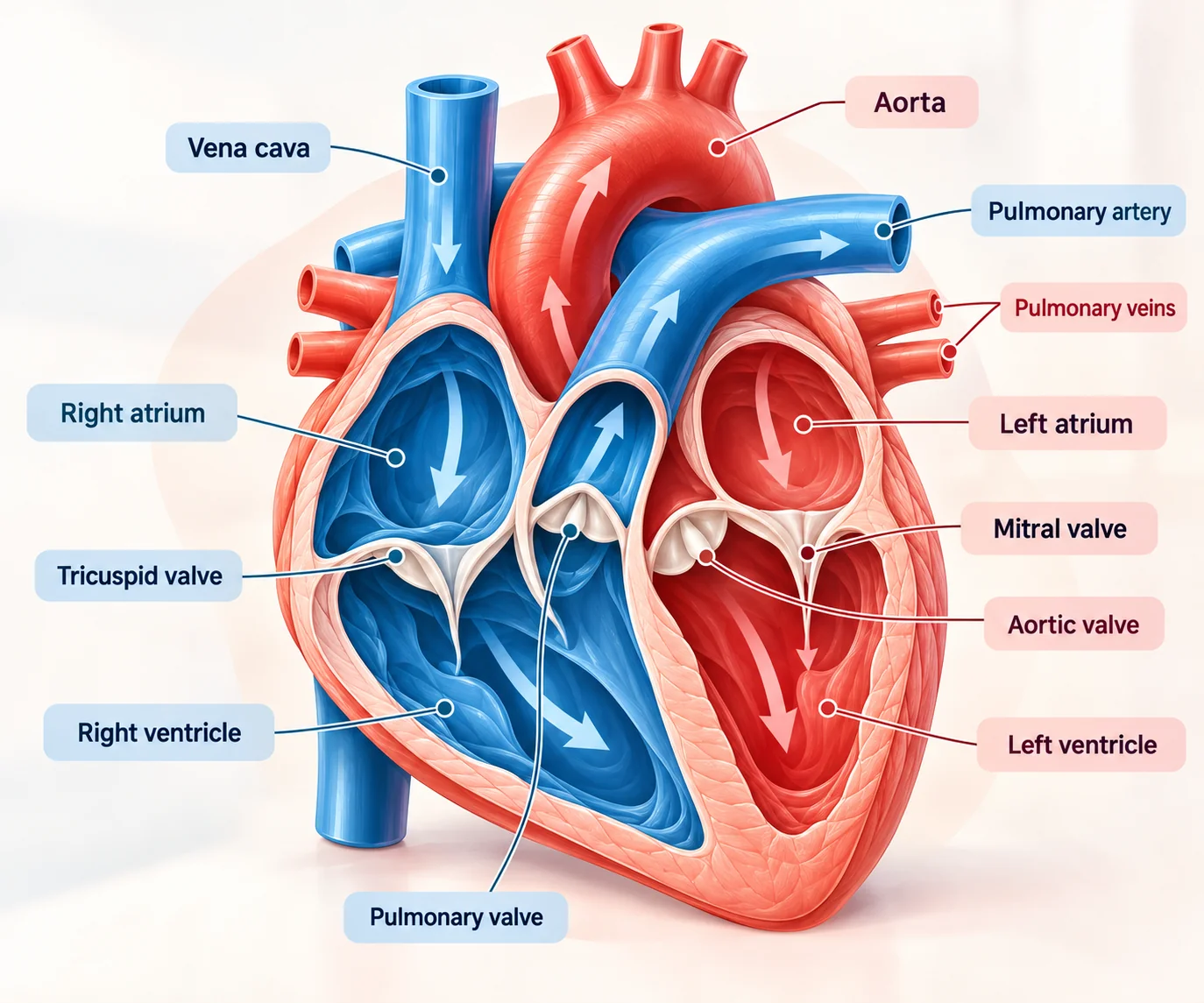
Imagine your heart as a house with four rooms.
Your heart has a right side and a left side, separated by a muscular wall called the septum. Each side contains an upper chamber and a lower chamber.
These four chambers have different jobs.
The two upper chambers are called the atria:
- Right atrium: Receives oxygen-poor blood returning from the body.
- Left atrium: Receives oxygen-rich blood coming from the lungs.
Think of the atria as the rooms where blood enters the heart.
The two lower chambers are called the ventricles:
- Right ventricle: Pumps blood towards the lungs.
- Left ventricle: Pumps oxygen-rich blood around the body.
These are the heart’s main pumping chambers.
And just like a house has doors between rooms, your heart has something similar: valves.
There are four valves in total. They open to allow blood to move forward and close to prevent it from flowing backwards.
The clever part is how the chambers and valves work together to keep blood moving in the right direction.
Medical reference: American Heart Association — Heart Valves and Circulation
3. How Does Blood Travel Through Your Heart and Body?
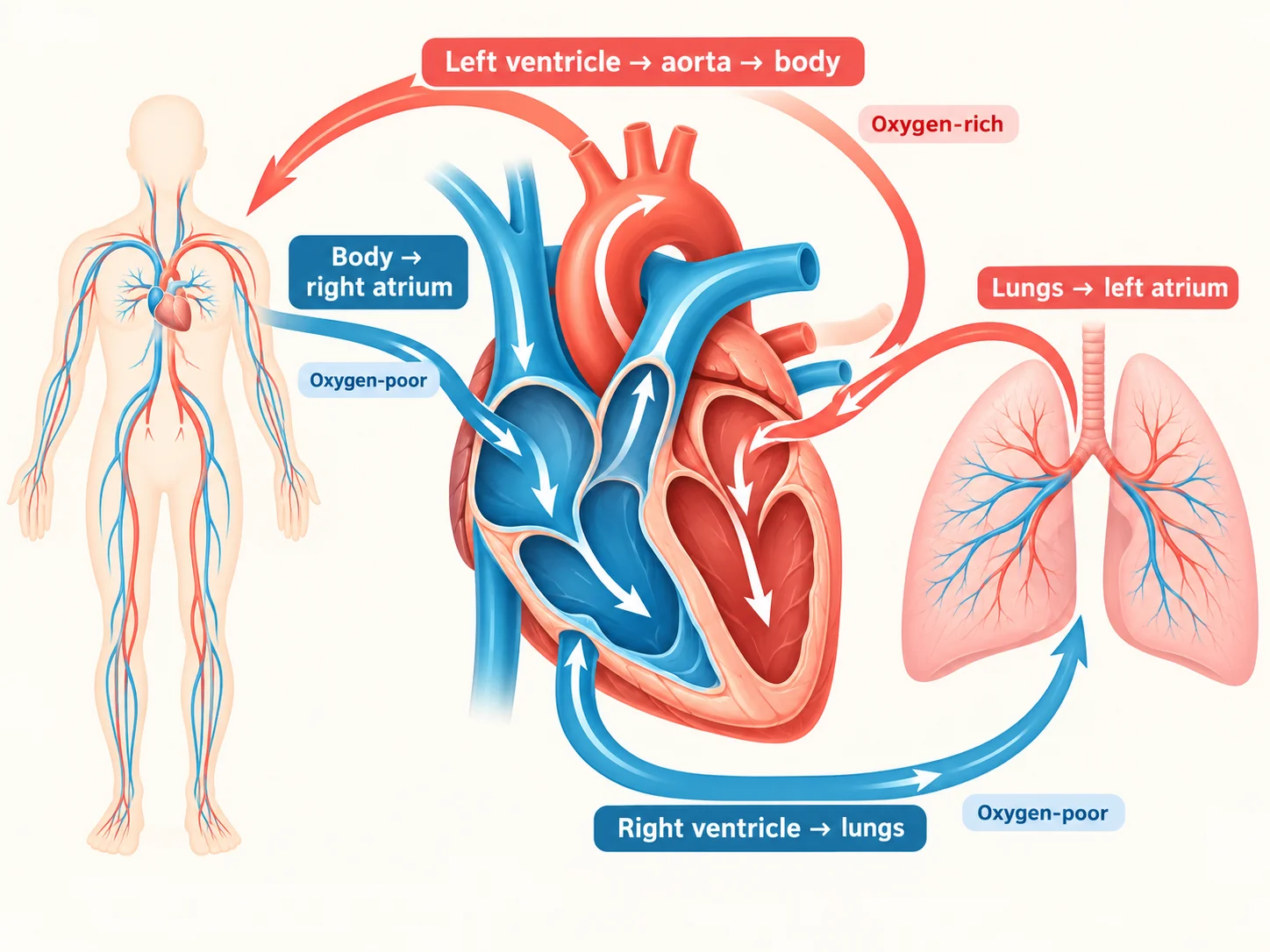
Now that we know the rooms and doors of the heart, let’s follow a drop of blood on its journey.
First Stop: From the Body to the Heart
As blood travels around your body, it delivers oxygen to your organs and tissues.
After delivering oxygen, the blood returns to the heart through large blood vessels called veins.
This oxygen-poor blood enters the right atrium, the upper chamber on the right side of your heart.
From here, it passes through a valve called the tricuspid valve into the right ventricle.
Remember our doors analogy?
The tricuspid valve acts like a one-way door. It opens to let blood pass into the ventricle and closes when the ventricle contracts, preventing blood from flowing backwards.
Next Stop: From the Heart to the Lungs
The right ventricle then pumps this blood through another valve, called the pulmonary valve, into a blood vessel known as the pulmonary artery.
This artery carries oxygen-poor blood to the lungs.
In the lungs, something important happens.
The blood releases carbon dioxide and picks up fresh oxygen from the air you’ve breathed in.
Now it’s ready to deliver oxygen to the rest of your body again.
Third Stop: Back to the Heart
The newly oxygen-rich blood travels from the lungs through blood vessels called the pulmonary veins.
These veins carry it into the left atrium.
Here’s an interesting fact: Arteries don’t always carry oxygen-rich blood, and veins don’t always carry oxygen-poor blood. What makes them different is the direction of blood flow: arteries carry blood away from the heart, while veins bring it back.
From there, the blood passes through another one-way door, the mitral valve, and enters the left ventricle.
Final Stop: Out to the Whole Body
The left ventricle is the heart’s main pumping chamber for the rest of the body.
When it contracts, it pushes oxygen-rich blood through the aortic valve into a large blood vessel called the aorta.
The aorta branches into smaller arteries that carry blood to your organs, muscles and other tissues.
And once the blood has delivered its oxygen, it makes its way back to the right side of the heart.
That’s the journey: Body → Right Heart → Lungs → Left Heart → Body.
And the cycle continues with every heartbeat.
Medical references: NIH/NHLBI — How Blood Flows Through the Heart and American Heart Association — How the Healthy Heart Works
4. What Happens During a Heartbeat?
So far, we’ve followed the path of blood. But what actually happens when your heart beats?
Your heart works through a repeated cycle of relaxing and contracting.
There are two main phases.
Diastole — when the heart relaxes and fills
During this phase, the ventricles relax, allowing blood to flow into them from the atria.
Think of a pump drawing water into its chamber before pushing it out.
Systole — when the heart contracts and pumps
The ventricles squeeze, pushing blood out of the heart.
The right ventricle sends blood towards the lungs, while the left ventricle pushes blood into the aorta and towards the rest of the body.
These two phases happen again and again, creating your heartbeat.
Interestingly, the terms systolic and diastolic may already sound familiar.
They’re also used when measuring blood pressure.
For example, in a blood pressure reading of 120/80 mmHg:
- 120 (systolic): The pressure in your arteries when the ventricles contract.
- 80 (diastolic): The pressure in your arteries when the ventricles relax between beats.
These numbers represent pressure, not your heart rate.
Medical reference: NIH/NHLBI — How the Heart Beats
5. What Keeps Your Heart Beating?
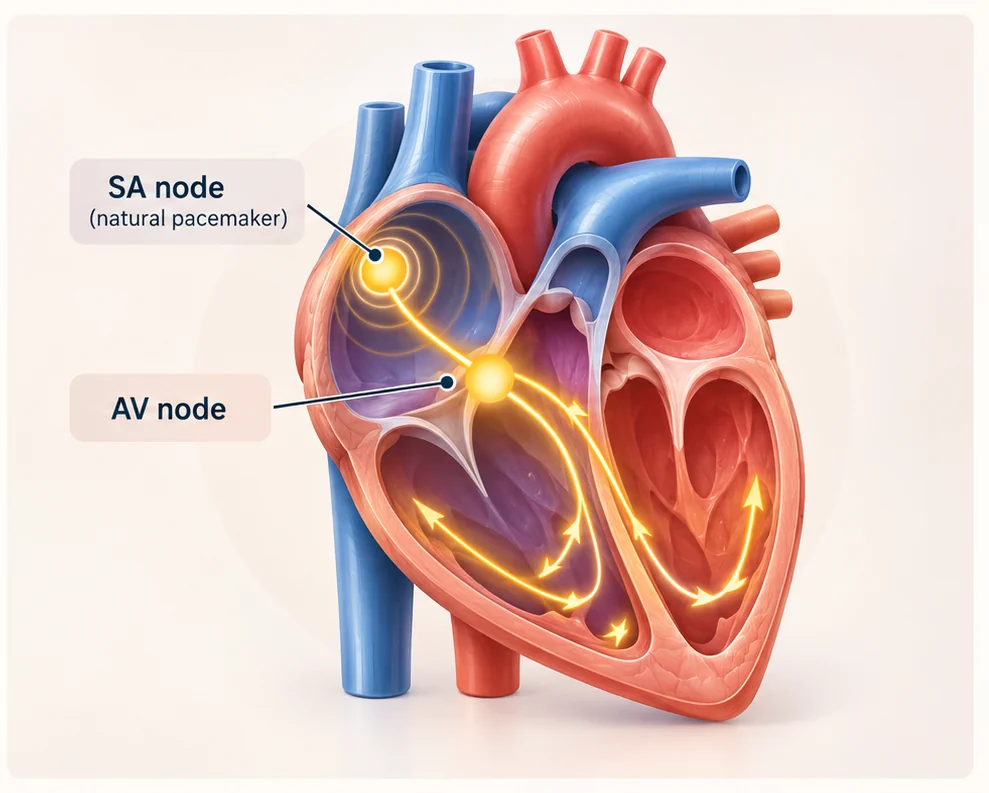
Here’s another interesting question.
If the heart is a pump, what tells it when to pump?
The answer lies in its own electrical system.
Your heart contains specialised cells that produce and carry electrical signals. These signals help its chambers contract in an organised sequence.
Each normal heartbeat begins with an electrical signal from a small group of cells called the sinus node, or SA node, located in the right atrium.
You can think of it as the heart’s natural pacemaker.
The signal spreads through the upper chambers, making them contract and help move blood into the ventricles.
It then passes through a connection called the AV node, where there is a brief delay before the signal travels through the ventricles, making them contract.
This timing helps the upper and lower chambers work together.
The electrical system provides the timing, while the heart muscle does the pumping.
Medical references: British Heart Foundation — How a Healthy Heart Works and NIH/NHLBI — How the Heart Beats
6. How Does Your Heart Get Its Own Blood Supply?
We’ve talked about how the heart delivers blood to the rest of your body.
But the heart is a muscle itself. So where does it get its own oxygen?
It has a dedicated blood supply through vessels called the coronary arteries.
These arteries branch from the aorta and supply oxygen-rich blood to the heart muscle, allowing it to keep working.
If blood flow through a coronary artery becomes severely reduced or blocked, part of the heart muscle may not receive enough oxygen.
A sudden blockage, often caused by a blood clot forming over a disrupted plaque, is the usual mechanism behind a heart attack.
If you’d like to understand this better, read our article Heart Attack: 5 Warning Signs You Should Never Ignore.
Medical reference: NIH/NHLBI — Coronary Blood Supply
7. How Does Your Heart Respond to Exercise and Rest?
Have you noticed how your heartbeat becomes faster when you walk briskly, climb stairs or exercise?
That’s because your muscles need more oxygen and nutrients when they’re working harder.
To meet this increased demand, your heart usually beats faster and pumps more blood.
When you slow down and rest, your body’s oxygen needs generally decrease, and your heart rate usually slows as well.
Your heart adjusts its activity according to what your body needs.
This is one reason regular physical activity is important for cardiovascular health.
A quick safety note: It’s normal for your heart to beat faster during exercise. However, if you experience chest pain, dizziness, unusual breathlessness or a racing or irregular heartbeat that feels concerning, stop exercising and seek medical advice. If you develop symptoms suggesting a heart attack, call your local emergency services immediately.
If you have an existing heart condition or have been advised to limit physical activity, discuss a suitable exercise plan with your healthcare professional.
If you’re looking for a gentle way to get started, explore our free 4-Week Walking Challenge, designed to help beginners gradually develop a walking habit.
Medical references: British Heart Foundation — Heart Rate and Exercise, British Heart Foundation — Exercising Safely with a Heart Condition and American Heart Association — Developing a Safe Physical Activity Plan.
The Takeaway: A Lot Happens With Every Heartbeat
Your heart may be only about the size of your fist, but the work it performs is remarkably well coordinated.
Its four chambers receive and pump blood. Its valves help keep that blood moving in the right direction. Its electrical system coordinates each heartbeat, while its coronary arteries supply the heart muscle with the oxygen it needs.
All these parts work together to keep blood circulating throughout your body.
And now, the next time you feel your pulse, you’ll know a little more about what’s happening behind every beat.
Understanding how your heart works is a useful first step towards understanding how to look after it.
Frequently Asked Questions (FAQs)
1. Is your heart really on the left side of your chest?
Not entirely. Your heart sits near the centre of your chest, between the lungs. It is tilted slightly towards the left, with its tip, called the apex, pointing downwards and to the left.
2. Why does my heart beat faster during exercise?
When you exercise, your muscles need more oxygen. Your heart responds by beating faster and pumping more blood to help meet that demand.
3. What is the difference between heart rate and blood pressure?
Your heart rate is the number of times your heart beats per minute.
Your blood pressure measures the force exerted by circulating blood against the walls of your arteries.
They are related, but they measure different things.
4. Does your heart stop or rest when you’re sleeping?
Your heart continues pumping throughout sleep.
Your heart rate often slows during sleep as your body’s activity and oxygen demands decrease, but your heart never stops working under normal conditions.
References
- British Heart Foundation. How Your Heart Works.
https://www.bhf.org.uk/informationsupport/how-a-healthy-heart-works - American Heart Association. Heart Valves and Circulation.
https://www.heart.org/en/health-topics/heart-valve-problems-and-disease/about-heart-valves - National Heart, Lung, and Blood Institute (NIH). How Blood Flows Through the Heart.
https://www.nhlbi.nih.gov/health/heart/blood-flow - American Heart Association. How the Healthy Heart Works.
https://www.heart.org/en/health-topics/congenital-heart-defects/about-congenital-heart-defects/how-the-healthy-heart-works - National Heart, Lung, and Blood Institute (NIH). How the Heart Beats.
https://www.nhlbi.nih.gov/health/heart/heart-beats - British Heart Foundation. Heart Rate and Exercise.
https://www.bhf.org.uk/informationsupport/how-a-healthy-heart-works/your-heart-rate - Centers for Disease Control and Prevention (CDC). How the Heart Works.
https://www.cdc.gov/heart-defects/how-the-heart-works/index.html - British Heart Foundation. Exercising with a Heart Condition: Finding a Safe Level for You.
https://www.bhf.org.uk/informationsupport/heart-matters-magazine/activity/finding-safe-exercise-limits - American Heart Association. Develop a Physical Activity Plan for You.
https://www.heart.org/en/health-topics/cardiac-rehab/getting-physically-active/develop-a-physical-activity-plan-for-you
Medical Disclaimer: This article is intended for general health education and does not replace personalised medical advice, diagnosis or treatment.
General education only; not individual medical advice. Speak with a qualified healthcare professional about personal health concerns.
For a suspected emergency, call your local emergency service immediately.